What Shomyo taught me about playing slowly
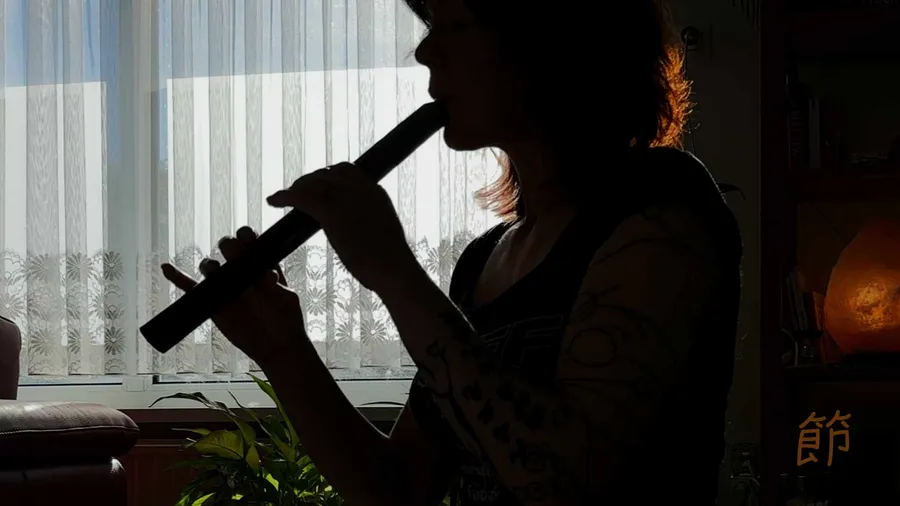
I’ve wanted to listen to shomyo for a while.
Shomyo is Buddhist chanting — the kind that would have been part of the daily soundscape for many hitoyogiri players living in Muromachi-era Japan. Just like for us today, there was a soundscape for each layer of society. Hitoyogiri developed mainly in scholarly and monastic contexts, therefore its music is imbued with those specific flavours. The kind that we bathe in and that softly get absorbed into our own soundscape, without us even noticing. So, when a teacher told a hitoyogiri player to add a yuri here, they didn’t need an explanation. They already knew what a yuri felt like, because they had heard it in Buddhist chanting, in Noh theater, in Shinto ritual. It lived in their bodies before they even picked up a flute.
For us, it doesn’t. We come to this music as outsiders, piecing things together from written instructions or with the ancient disciplines that survived to this day relatively unchanged. But we miss the cultural scaffolding that once made it easy. So I’ve been hoping to build some of that scaffolding for myself by listening to Gagaku, Nohkan, and Shomyo. The first two can be found online, but the latter, if it still exists in Japan, is extremely hard to find anywhere else.
My searches had failed repeatedly, and I was about to give up on Shomyo entirely when Nick dedicated an entire lesson to it. In this lesson only, I have already learned two things that changed the way I play.
The music sheet
In hitoyogiri notation, a yuri — the gentle repeating of a note, is represented by dots. Five dots stacked vertically means you play a given note five times before moving on. That’s it. Unless we get specific instructions, there is no indication of shape, no sense of how the wave is supposed to rise and fall, no means to know whether it should end abruptly or dissolve gently into the next sound.
Shomyo solves this differently. Instead of dots, it draws a line. The line undulates across the page, showing you exactly when the tone lifts and when it settles back down, how long the wave lasts, whether it ends on an upward flick or trails off. It is, in the most literal sense, a picture of sound.
Seeing that line changed something for me. Suddenly the yuri wasn’t an abstract instruction — it had a shape. And in hitoyogiri music, that shape is different depending on the season. In Spring, the wave is bigger, fuller, like sap rising. In the interseason — the doyo period I’m in now, those transitional weeks between Spring and Summer — it flattens out. You barely perceive its tremor. Seeing that drawn out made it intuitive in a way that dots never had.
The space inside a single sound
The second thing shomyo taught me is harder to explain, but it might be the more important one.
I like to play slowly. I’ve always known that. But I also have this fear that slow is boring — that if I linger too long on a single note, whoever might be listening will drift away. So I rush, just a bit. But sometimes, it’s enough to keep me from fully inhabiting what I’m playing.
Then I saw this shomyo music sheet, and on it, a single syllable — I think it was “ga” — was taking up half the page. Three full lines, bending and curving, tracing the entire life of that one sound. In contemporary music, that space would hold five or six sentences. Here it held one word, fully unfolded.
It struck me.
Because what that page was saying is that the sound itself is the point. The note you are playing right now is the achievement. It contains everything.
I’ve heard this idea before — in Buddhism, in the practice of sitting. The instruction to stay with what is, rather than already leaning toward what comes next. But I hadn’t fully felt it in music until that moment. Each note in hitoyogiri music is a finite thing. It gathers energy, reaches something like a tipping point, and then either fades or turns into something else. Your job, as the player, is to be present enough to feel when that moment arrives and let it happen.
Being able to do that, to me, is very close to zazen. Not a replacement for sitting — nothing replaces sitting — but the same quality of attention, applied to sound. The same instruction: stay here. Just stay.
All terrain
I’ve said before that shakuhachi, to me, is a meditative practice and hitoyogiri is “all terrain” — meditation, expression, anything the moment brings. I stand by that. But what I’m finding, the longer I play, is that the “terrain” of the hitoyogiri includes this too — a stillness inside the movement, a presence inside the phrase. It’s not a solemn instrument. It can carry joy, and mood, and the particular lightness of a June morning when you take out music you haven’t touched in months and find that your hands — and ears still remember most of it.
But it can also hold you very still, inside a single note, until you lose yourself for the best.
That’s where I want to live, I think. Right at that edge.